
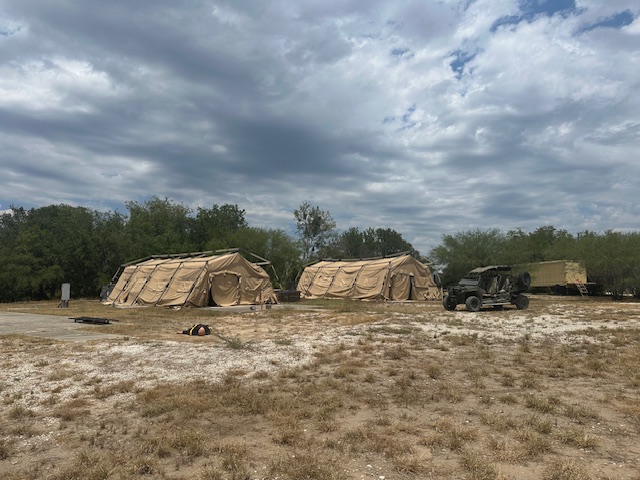
Military and remote medical teams operate in some of the most unpredictable environments in healthcare. Limited light, unreliable power, mobility demands and high-acuity patients all challenge traditional monitoring equipment. That’s why realistic field testing matters.
A recent training-based evaluation put the Guardian Vitals app to the test in a simulated forward-deployed medical setting. The goal was simple: understand how the system performs in the kinds of environments where prolonged field care and Role II medicine happen every day. Role II medical treatment facilities are mobile, forward-deployed units designed to provide advanced trauma resuscitation and damage control surgery close to the battlefield.
Testing During Real-World Medical Training
The assessment took place during medical sustainment training at Joint Base San Antonio through the VAPOR program, the Validated Assessment Program for Operational Readiness, in partnership with TRC-4. Rather than a lab-style test, the device was used during realistic patient intake exams and acute pain assessments inside a simulated Role II facility.
Medical staff received on-site instruction and used the platform throughout multiple training scenarios. Evaluators observed start-up, usability and overall performance while teams worked through patient care tasks under simulated operational stress.
What Do You Look for in Austere Medical Monitoring?
When equipment is used in field medicine, performance goes beyond basic functionality. This evaluation focused on how Guardian Vitals handled key operational demands, including:
- Usability in low-light environments
- Battery performance during extended operations
- Portability for mobile medical teams
- Durability in unconventional and resource-limited care settings
These are the conditions that define austere medical environments, where reliable vital signs monitoring can directly influence triage, treatment decisions and patient outcomes.
Six Months of Simulated Use
Over a six-month observation period, the Guardian Vitals app was used 10 times across training scenarios and demonstrations. Teams monitored 25 simulated patients presenting with both combat-related trauma and general medical conditions.
Vital sign information was relayed to a Role II provider, supporting care decisions during prolonged field care scenarios. The device’s size, weight and cabling did not create operational barriers during training use, an important factor for teams balancing mobility and capability.
Where Did the Device Fit Best?
While the platform demonstrated it could function in multiple environments, evaluators noted it is especially well-suited for traditional medical facilities where reliable power is available. Its capabilities were particularly valuable for continued patient monitoring in the Role II setting, where sustained observation plays a key role in patient management.
Perhaps most importantly, evaluators emphasized the system’s contribution to medical situational awareness, giving providers clearer, more consistent insight into patient status during complex care situations.
Why More Training Programs Should Consider Testing
No single evaluation answers every operational question. That is why exposure across different units, training pipelines and mission profiles is so important.
Training-based assessments like this allow medical teams to:
- See how monitoring technology performs under a realistic workload
- Identify where a system best fits within their level of care
- Evaluate usability before operational adoption
- Strengthen clinical decision-making tools in prolonged field care
As military and remote medicine continue to evolve, so does the need for adaptable, field-ready monitoring solutions. Expanding hands-on testing across training environments helps ensure the right tools are in the right hands when it matters most.
Organizations interested in evaluating vital signs monitoring technology in austere or Role II training settings may benefit from incorporating systems like Guardian Vitals into upcoming exercises and medical readiness programs.